
What we hope for from you
- If it seemed relevant to you, access to an annotated French cohort of children aged 8 to 13 (consensus ground truth) would be invaluable to us. This is our main blocker: this age range is almost absent from the literature, and all our results — obtained on adolescents — remain to be tested on it.
- And, in time, the perspective of a child psychiatrist to clinically validate the thresholds, our sensors having been tested only on adults.
New results (proof_fusion.py, 27 active features):
- Run 4 — absolute record at FP 5% · config SENS+STRUCT · FR+CyberAgressionAdo · recall 61% · bullying 85%.
Data: crashtest-v2 FR + Sprugnoli WhatsApp FR + 3,015 real CyberAgressionAdo-v2 messages. Features B3: silence >2h + night-time hours 2am-5am. Level: semi-real/balanced. - Run 5 — B5 reciprocity regressive · FP 5%→21%. B5 disabled pending multi-participant data.
Data blocker: De Kindertelefoon / krisenchat / TRAILS corpora required. - Run 6 — CyberAgressionAdo-Large (night of 13/06) · config SENS+STRUCT · FR+CyberLarge · FP 2% · recall 62% · bullying 74% (+6 pts vs Run 4).
Data: + 5,608 real CyberAgressionAdo-Large messages (Zenodo, 36 scenarios). The v2+Large combination (bullying=63%) is less effective than Large alone — the two corpora add noise to each other. Provisional champion candidate: FR+CyberLarge. To be confirmed over more runs.
Honesty about the "signature" of the whisper (updated 14/06/2026): we tested two structural-signature hypotheses on real data, and we publish both negative results. (1) "The victim disappears / goes silent" — retracted: it was a parsing artefact of the Sprugnoli corpus (8 conversations out of 10 had a timestamp in place of the speaker). (2) "Convergence" (several against one) — visible on Sprugnoli (role-play, 72%) but NOT confirmed on real data with a control: non-discriminative on Conversations Gone Awry (Cornell, AUC ≈ 0.49) and a minority (≤ 18%) on OAA. Honest conclusion: no structural signature is, to date, validated on real data. The detector relies on content (an explainable classifier, at its known ceiling); the real blocker remains access to longitudinal group data with healthy control groups.
Methodological note: the FP figures quoted (Run 4: 5%, Run 6: 2%) are measured on a balanced semi-real dataset, not on the real SMS/chat register. The two figures are not directly comparable to the 5.40% of the rules engine (§7).
Quantified summary — calibrated, without over-claim
Cross-cutting warning: all our empirical results concern adolescents (12-17 years), never the target group (8-13 years). Pre-adolescence differs qualitatively (indirect aggression peaks around 11-13 years, language and usage change). Each figure below is therefore an optimistic upper bound for the target population, to be recalibrated.
Problem and stakes
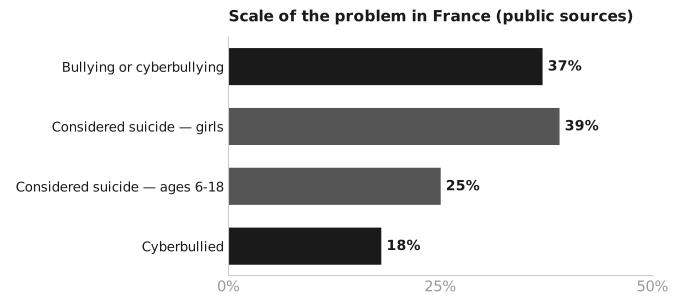
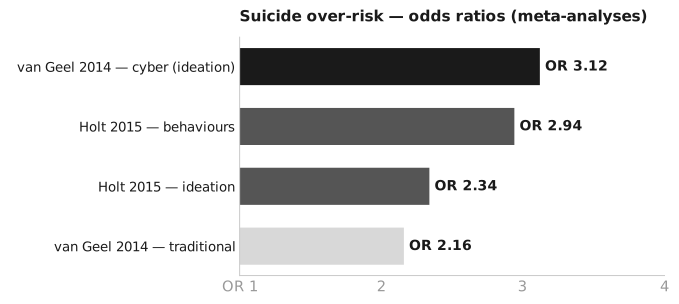
School bullying and its digital extension are widespread, and their consequences can be grave, sometimes dramatic (without being systematically lethal). In France, according to self-reported figures, 18% of young people report being cyberbullied (INSEE Références 2025 / DEPP) and 37% report bullying or cyberbullying (e-Enfance/3018, Caisse d'Épargne–Audirep barometer, May 2025); these rates measure self-reported violence in a broad sense, and not bullying in the strict Olweus sense (repetition, duration, intent to harm, power imbalance). Among 6-18-year-old victims, 25% report having thought about suicide or self-harm, 39% among girls (e-Enfance 2025). Suicide is the 2nd cause of death among 15-24-year-olds (Santé publique France 2023). International (non-French, 2014-2015) meta-analyses suggest an association with an excess risk of suicidal ideation and behaviours — and not a direct mortality: van Geel et al. (JAMA Pediatrics 2014, n=284,375) report an OR of 3.12 vs 2.16 for ideation; Holt et al. (Pediatrics 2015) an OR of 2.34 (ideation) and 2.94 (suicidal behaviours).
The blocker is not explicit bullying (insults, threats), already well caught by rules. It is veiled bullying — repeated mockery without insult, silent exclusion, innuendo, group irony. This is exactly the canonical construct of relational aggression (Crick & Grotpeter, 1995; Björkqvist, Lagerspetz & Kaukiainen; Underwood) — a form of violence that targets the tie and the status, whether it travels through a direct or indirect channel. Its charge is not in the words but in the repetition, the relationship and the effect on the target — which makes it invisible to lexical filtering. An additional structural blocker: end-to-end encryption (iMessage, Signal, WhatsApp native on iOS) makes these channels opaque (0% detection possible). Any solution must therefore operate where the text is readable by the child themselves: on their device.
The data: consensus annotation of a public French corpus
Data is the project's true bottleneck, not the model. Our ground-truth foundation is CyberAgressionAdo (Ollagnier et al., CNRS, Zenodo 14770265): 5,608 messages from real French adolescents' conversations, anonymised. This corpus is public and published — what is new is our annotation layer by multi-rater consensus, not the corpus itself. We attribute the contribution clearly: protocol and labels, never the resource.
Composition annotated by consensus: 202 conversations (118 "whisper", 61 "clear (nothing-to-report)", 23 "ambiguous"). An ultra-strict subset of 69 "gold" conversations serves as the highest-quality benchmark.
In parallel, a gamified collection campaign (16 games, ~194 root first-names — conservative estimate, possibly over-estimated, to be refined, 6,088 responses over 12.5 days, 27 May – 9 June) fed the annotation. This count and that of the annotation measure different things and do not combine arithmetically.
Derived extensions — to be downgraded to exploratory / illustrative
Two synthetic datasets exist and must, for consistency with the lesson of the 0/17 ("synthetic does not transfer to real"), be treated as purely exploratory/illustrative, never evaluative: GroomingFR-Synth v1 (9,002 synthetic messages, CC BY-NC 4.0) and a non-adversarial control corpus of 720 synthetic neutral messages. The latter serves to illustrate the false-positive behaviour, but its 0.00% is optimistic and not predictive (section 7).
| Class | n | Share | Level |
|---|---|---|---|
| Whisper (veiled aggression) | 118 | 58% | real |
| Clear (nothing-to-report) | 61 | 30% | real |
| Ambiguous | 23 | 11% | real |
| Consensus total | 202 | 100% | |
| Ultra-strict gold subset | 69 | — | real |
| Labels via crowd collection (median votes/conv.) | 177 | — | crowd setup |
| Panel for Krippendorff's alpha (raters) | 9 | — | panel setup |
Central result: isolated message versus full thread
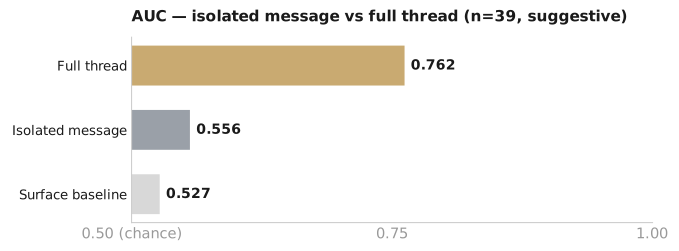
On the same real corpus and the same metric (AUC, n=39 conversations), an isolated message is almost indistinguishable from noise (AUC 0.556, barely above a surface baseline of 0.527), whereas the full thread becomes discriminative (AUC 0.762, apparent gain +0.21). This is consistent with the idea that the charge of the whisper is in the trajectory, not in the message.
The progression scale: from surface to on-device
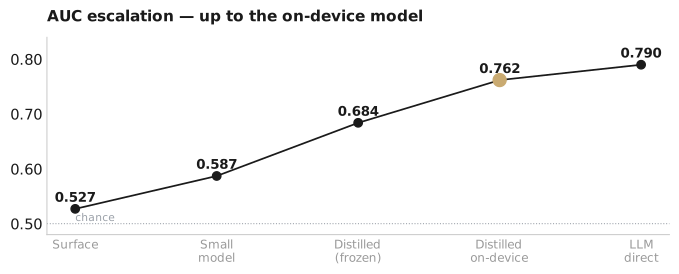
Performance progresses in steps. In AUC: surface 0.527 → small model 0.587 → frozen distilled model 0.684 → on-device distilled model 0.762 → language model ~0.79. The on-device version approaches the language model while running on the device — reading the thread locally, with that content never transmitted nor shown to a human. Important caveats: (1) the 0.762 is a point value on small n, non-significant on the only held-out tested (0.72, p=0.43, §12); (1b) numerical coincidence not to be over-interpreted: the 0.762 of the "full thread" in the ablation (§3) and the 0.762 of the "on-device distilled" model (here, §4) are two distinct measurements (window-vs-message ablation on one side, distillation/fine-tune on the other) that happen to land on the same value — it is not the same run reused; (2) these steps do not form a homogeneous learning curve — each step changes ≥1 condition (data volume, frozen vs fine-tuned model, sometimes a different held-out): it is a comparison of configurations, not a continuous progression measured on a single bench.
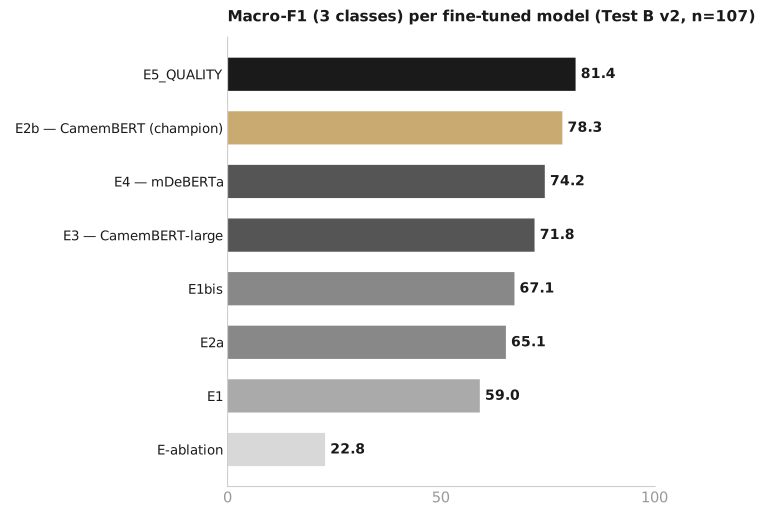
On the 3-class classification (macro F1, Test B v2 dataset — 107 scenarios balanced 50/50, hence semi-real: re-scripted excerpts, optimistic metrics, not the natural prevalence), the progression of the fine-tuned models goes from E-ablation 22.8% to E5_QUALITY 81.4%. Total cost of the 5 fine-tunings: ~22-25 USD.
Human reliability: humans too fail on the isolated message
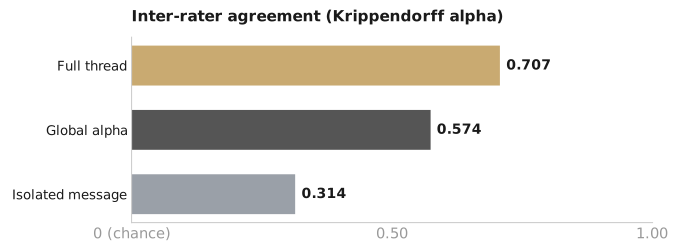
Before asking a machine to decide, one must know whether humans agree. The overall Krippendorff's alpha is 0.574, CI [0.31; 0.79] — moderate agreement, honestly weak at the bounds, and below the floor of 0.667 the project set itself. The breakdown is telling: on the isolated message, agreement drops to 0.314; on the full thread, it rises to 0.707. On the double-coded subsample of the reliability pilot (18 conversations, 9 raters), thirteen reach ≥80% agreement.
What we have cleanly ruled out
Rigour is also measured by what one eliminates. Four avenues tested then ruled out on real data, documented as negatives — not to be re-proposed.
- Keystroke (typing rhythm). Tested on DUX (36 subjects) and EmoSurv (124 adults). Indistinguishable as a reliable emotional marker, consistent with the literature. Ruled out.
- French encoders. 4 versions tested, indistinguishable from one another (~0.73 AUC each; the choice of encoder brings no marginal gain). The lever is not the encoder.
- Generic veil (simple veiled toxicity, ToxiFrench). On 25,838 examples, AUC 0.488 — statistically indistinguishable from chance (0.500) (an AUC slightly below 0.5 may signal noise or a label inversion, to be checked). Generic toxicity does not capture school whispering.
- Mini-LLM alone. GPT-4o-mini, reported at 75% recall on 30 English synthetic cases, dropped to 0/17 in ALARM recall on real French adolescent cases (11.8% on the whisper, 94.1% on the neutral ones). Public communication cancelled.
| Avenue | Data | Result | Verdict |
|---|---|---|---|
| Keystroke (typing rhythm) | DUX 36 + EmoSurv 124 (adults) | No reliable emotional marker | ruled out |
| FR encoders (4 versions) | — | ~0.73 AUC, indistinguishable from one another | ruled out |
| Generic veil (ToxiFrench) | 25,838 examples | AUC 0.488 ≈ chance (0.500) | ruled out |
| Mini-LLM alone (ALARM recall) | 17 real FR adolescent cases | 0/17 (0%) | ruled out |
(30 EN synthetic cases)
(17 real FR adolescent cases)
False positives, predictive value and distribution freeze
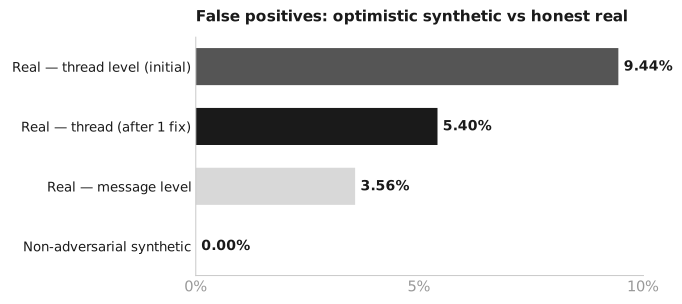
A detector that cries wolf is unusable. On the synthetic control corpus (720 neutral messages), the false-alert rate is 0.00% — but this corpus is non-adversarial, hence optimistic and not predictive. On a real French register (SMS/chat), the honest measurement is quite different: at the message level, E5 produces ~3.56% false positives; at the thread level, 9.44% initially, brought down to 5.40% after a first fix. Reservation: this fix was not validated on a held-out distinct from the evaluation bench — if it was tuned on the same register, the 5.40% is optimistic, to be re-measured out-of-sample (the real out-of-sample FP would probably be higher). At this stage, the distribution has been FROZEN.
The missing decisive figure: the positive predictive value (PPV)
Reporting recall alone masks the base-rate problem. Derived calculation (Bayes' formula, not measured, prevalence assumptions) from our figures: recall 60%, false positives 5.40% at the thread level. At realistic and low prevalence, the majority of alerts would be false on a child — a decisive figure for a tool affecting minors, and a prerequisite for the clinical validation in section 10. Acknowledged inconsistency in the calculation below: the 60% recall comes from a balanced 50/50 dataset (semi-real, optimistic) while the 5.40% false-positive rate comes from a real French SMS/chat register — these are two distinct datasets, and the real PPV is bleaker. At the real recall (6-21%, mid-range ~15%) with the same 5.40% FP, the PPV at 5% prevalence falls to ~13% (vs ~37% at the optimistic 60% recall): at realistic prevalence, nearly 9 in 10 alerts would be false alerts on a child.
| Assumed prevalence | Recall | False positives | Estimated PPV | Reading |
|---|---|---|---|---|
| 2% | 60% | 5.40% | ~18% | ~4 alerts out of 5 are false |
| 5% | 60% | 5.40% | ~37% | the majority of alerts remain false |
| 10% | 60% | 5.40% | ~55% | barely one alert in two is correct |
Systemic hypothesis and behavioural sensors
Network hypothesis: measuring the deformation of the social tie
A deeper hypothesis guides the R&D: bullying would be a loss of reversibility in the relational network (progressive exclusion, group pressure, asymmetric silence) — one would not measure the message but the deformation of the social fabric. This hypothesis rests on an established literature — bullying as a group process (Salmivalli et al., 1996) and social ostracism (Williams, 2009) — but it has not been tested by us on the target group. It is "consistent with" the hypothesis — never an established mechanism, and it must not steer the architecture as an established result.
8 behavioural sensors — validated on adults only
Eight sensors are wired in (typing, sleep, mobility, self-censorship, silence, dissonance…), all validated on adults/students, never on minors. A legitimate question from an evaluator: why pile up 8 sensors that cannot be validated on the target group rather than hardening the single signal that works? Honest answer: these are leads, not strengths, and each must be scientifically justified or abandoned. They remain here in reserve, outside the performance conclusions.
| Anchor | Reference | Contribution |
|---|---|---|
| Bullying = group process | Salmivalli et al., 1996 (Aggressive Behavior) | roles: ringleader, assistant, reinforcer, bystander, defender |
| Social ostracism | Williams, 2009 | exclusion / silence as a threat mechanism |
| Signed-graph balance | Cartwright & Harary, 1956 | "all against one" = converging negative edges |
Ethics as an architectural constraint — and its legal tensions
The ethical principles are wired into the architecture: (1) 100% on-device detection; (2) content is analysed locally, never transmitted, never stored, never shown to a human (a signal is derived, no copy is kept; the content detector reads the text, but locally and without it leaving the device — the latency/reaction layer, for its part, needs no content); (3) nothing to parents automatically; (4) the signal belongs to the child; (5) referral to a trusted third party (not necessarily the parents) and the 3018 helpline. Two technical safeguards: the bundle rule (no isolated sensor ever triggers; 7-day baseline, minimum 3 converging sensors) and the dentelle (lace) lock (across 24 settings, 0 games offered to a child in danger — final clinical adjudication). These are design decisions, not measured results.
| Commitment | Implementation | Nature |
|---|---|---|
| On-device detection | 100%, no server dependency | design |
| Content transmitted, stored or shown to a human | never — analysed locally, signal derived, no copy | design |
| Automatic reporting to parents | none | design |
| Ownership of the signal | the child (in tension with parental authority 8-13) | to be settled in law |
| Trusted third party + 3018 | yes | design |
| Bundle rule | min. 3 converging sensors, never a single one | design |
| Dentelle | 0/24 settings (CI upper bound ~12.5%) | not guaranteed at small n |
Roadmap — blockers by criticality
| # | Blocker | Why it blocks |
|---|---|---|
| 1 | Annotated FR 8-13 cohort | Field absent from the literature; no external baseline; the whole evidence chain (measured on adolescents) to be re-validated |
| 2 | Clinical validation of thresholds (child psychiatrist) | Sensors validated on adults only; dentelle/synthesis thresholds = unmeasured human adjudication → blocks deployment |
| 3 | Statistical consolidation (Phase C) | ≥196 scenarios (McNemar significance), DeLong on the foundational AUC, ECE/temperature-scaling recalibration, closing the whisper shortfall (50-60% balanced → 6-21% real) |
| 4 | End-to-end test on a real physical device | The only end-to-end proof still missing |
Data and computing resources
The domain's bottleneck is French data. The project combines public corpora, an original corpus annotated by adolescents, and a free, controlled computing infrastructure — a guarantee of reproducibility and of no data leakage.
| Corpus | Volume | Licence / source | Use |
|---|---|---|---|
| CyberAgressionAdo v1/v2 (Ollagnier, Cabrio, Villata, Blaya) | FR, multiparty | CNRS / HAL | core of the engine (FR whisper) |
| Shelkid in-house corpus | 6,088 responses · 16 games · ~194 root first-names (probably fewer — one participant produces several codes; pilot: 28 codes = 9 real children) | own collection, anonymous | adolescent consensus annotation |
| CoMeRe | 132,166 real FR SMS/chat | CC-BY | false-positive bench (real register) |
| SynBullying | 14,222 messages | EN + synthetic | roles, conversational harm |
| Sprugnoli (translated to FR) | 2,192 messages (role-play 12-13 years) | research | annotated exclusion (rare in FR) |
| Generic veil (ToxiFrench, MLMA-indirect, TRAC, ImplicitHate) | 25,838 examples | open licences | transfer test — negative result (AUC 0.488) |
| 4 FR encoders (CamemBERT v1/v2, DistilCamemBERT, mDeBERTa) | — | MIT / open | comparison (indistinguishable ~0.73) |
Computing infrastructure — free, dedicated, reproducible
All measurements (reproduction of the E5 champion, distillation, embeddings, fine-tuning) run on a dedicated GPU server, NVIDIA L40S 48 GB (ollama + PyTorch/CUDA stack), with no dependency on a paid API. This choice guarantees reproducibility, the absence of data transmission to a third party, and demonstrates the "on-device" feasibility: the distilled model (AUC 0.762) is sized to run on the child's device, the content never leaving the phone.
References (184)
References used or cited by the project, classified by domain. References whose precise details remain to be completed will be finalised before any formal publication. Duplicates consolidated.
Bullying, relational aggression & ostracism
1. Björkqvist & Lagerspetz (1988-1992) — indirect aggression. 2. Crick & Grotpeter (1995), Child Development 66(3). 3. Olweus (~1993-1996), rBVQ/OBVQ. 4. Salmivalli et al. (1996), Aggressive Behavior 22(1). 5. Salmivalli & Voeten (2004), PMC11851402. 6. Smith, P. K. — cyberbullying. 7. Salmivalli (1996+) — group roles. 8. Vaillancourt — status/cortisol. 9. Latané & Darley — bystander intervention. 10. Williams (2009) — ostracism. 11. Casper & Card (2017) — meta-analysis. 12. Cyberball (Williams et al.). 13. Sargioti et al. (2022), DABSS, PMC9969485.Networks & group dynamics
14. Vicsek (1995). 15. Cartwright & Harary (1956). 16. Heider (1946). 17. Ballerini & Cavagna (2012).Sequential detection & weak signal
18. Neyman-Pearson. 19. Page (1954), CUSUM. 20. Donoho & Jin (2004), Higher Criticism. 21. SPRT. 22. eRisk CLEF 2024/2025 (ERDE), CEUR-WS Vol-3740/4038. 23. SINAI (2025), arXiv:2509.19861.Self-excitation & contagion
24. Hawkes (1971). 25. Masuda et al. 26. Soni et al. (2020), FM-Hawkes. 27. Rizoiu et al. (2017/2020), arXiv:2006.06167. 28. Yao, Chelmis & Zois (2020/2021), 10.1145/3441141.Stigmergy, quorum, thresholds & phases
29. Bonabeau & Theraulaz. 30. Keller & Segel (1971). 31. Bassler & Miller. 32. Newman — percolation. 33. Granovetter (1978). 34. Hegselmann & Krause. 35. Noelle-Neumann — spiral of silence. 36. Ising (mean field).Reciprocity, reconciliation, anthropology
37. Nowak & Sigmund — indirect reciprocity. 38. Ohtsuki — leading-eight. 39. Nowak (1992+). 40. de Waal & van Roosmalen (1979). 41. Strauss (2019) — hyenas. 86. Girard (1972/1982). 87. Minuchin (1974). 88. Cybernetics (feedback). 89. Hatfield — emotional contagion.Linguistics & pragmatics
42. Searle (1975). 43. Grice (1975). 44. ElSherief et al. (EMNLP 2021), Latent Hatred. 45. Menini & Moretti (FBK/IRIT). 46. Lu et al. (Georgia Tech, 2025) — victim-centered.NLP / toxicity / hate speech & corpora
47. Van Hee et al. (2018), AMiCA, PLOS ONE. 48. Ollagnier, Cabrio, Villata & Blaya (2022/2024), CyberAgressionAdo, LREC/LREC-COLING/TAL. 49. Cheng, Silva & Liu (HANT). 50. Losada, Crestani & Parapar (eRisk). 51. Danescu-Niculescu-Mizil et al. (Cornell 2018), Conversations Gone Awry. 52. Hartvigsen et al. (~2022), ToxiGen. 53. Sprugnoli (2018, FR transl. 2026), W18-5107. 54. SynBullying. 55. TRAC-1. 56. MLMA. 57. HateCheck. 58. M-Phasis (LREC 2022). 59. CAD (CC-BY-4.0). 60. ConvAbuse (CC-BY-4.0). 61. ImplicitHate. 62. Civil Comments (CC0). 63. CoMeRe (132,166 msgs, CC-BY). 64. "What's up, Switzerland?" (UZH). 65. 88milSMS. 66. textdetox FR. 67. French Hate Superset. 68. ToxiFrench (Sciara et al. 2025), arXiv:2508.11281. 69. Jigsaw / Perspective API. 70. Detoxify / XLM-R toxic.Transformers & French models
71. Martin et al. (2020), CamemBERT, arXiv:1911.03894. 72. Antoun, Sagot & Seddah (2023), CamemBERTa, arXiv:2306.01497. 73. Antoun et al. (2024), CamemBERT 2.0, arXiv:2411.08868. 74. cmarkea (2022), DistilCamemBERT. 75. Le et al. (2020), FlauBERT, arXiv:1912.05372. 76. He et al. (2021), DeBERTaV3, arXiv:2111.09543. 77. Conneau et al. (2020), XLM-R, arXiv:1911.02116. 78. Caselli et al. (2020), HateBERT, arXiv:2010.12472. 79. Hinton, Vinyals & Dean (2015), Distillation, arXiv:1503.02531.Grooming & manipulation
80. O'Connell (2003). 81. Street et al. (2024), arXiv:2409.07958. 82. BF-PSR (USP). 83. PAN12/PANC, Vogt et al. (2021), ACL. 84. Park et al. (2025), SCoRL, arXiv:2503.06627. 85. Patronus AI (2024).Calibration & uncertainty
124. Platt (1999). 125. Zadrozny & Elkan (2002), KDD. 126. Vovk, Gammerman & Shafer (2005). 127. Gal & Ghahramani (2016), arXiv:1506.02142. 128. Lakshminarayanan et al. (2017), arXiv:1612.01474. 129. Manokhin (2024), TACL.Temporal & multi-actor architectures
130. Gu & Dao (2023), Mamba, arXiv:2312.00752. 131. Jacobs, Van Hee & Hoste (2020), arXiv:2010.06640. 132. Pradhan et al. (2024), ESIHGNN, arXiv:2405.03960. 133. Jiao et al. (2020), PMC8625403. 134. Losada & Crestani (2016), CLEF eRisk.Additional arXiv (2025-2026)
135. Chehbouni et al., arXiv:2501.12537 (AAAI 2025). 136. Langlais et al. — backtranslation, ~1.7 M synthetic FR tweets. 137. Park et al., arXiv:2503.06627 (NAACL 2025). 138. arXiv:2502.12563 (2025). 139. Sciara et al., arXiv:2508.11281.Mycology & criticality (counter-examples)
90. Simard — Wood Wide Web (debated hypothesis). 91. Karst, Jones & Hoeksema (2023), Nature Ecology & Evolution. 92. Bak (1996+) — self-organised criticality.Prevalence & public health (France/Europe)
93. INSEE Références 2025 (SSMSI/DEPP). 94. e-Enfance/Caisse d'Épargne (2024, Audirep). 95. Santé publique France (2023). 96. Senate Report (2021). 97. EU Kids Online (LSE). 98. JRC Commission EU (2025). 99. Görzig, Milosevic & Staksrud (2017). 100. European Child & Adolescent Psychiatry (2022). 101. Tippett & Wolke (2014). 102. Arcep/CREDOC (2024). 103. DEPP (2024). 104. Elfe/Inserm cohort. + van Geel et al. (JAMA Pediatrics 2014, n=284,375); Holt et al. (Pediatrics 2015).French research (Blaya, Debarbieux)
105. Blaya (2025), La cyberviolence, Que sais-je ?, PUF, ISBN 9782715429345. 106. Blaya, L'école à l'ère du 2.0, HAL halshs-03534707. 107. Blaya et al., CyberAgressionAdo-v1, HAL hal-03765860. 108. Debarbieux, Du climat scolaire (MEN). 109. Debarbieux (2011), Refuser l'oppression quotidienne.Educational programmes & framework
110. KiVa (Turku). 111. Kärnä et al., PubMed 23659182. 112. Olweus (Norvège). 113. Eoullim (Corée). 114. NIER/kokoro (Japon). 115. FUSE (Irlande). 116. Common Sense. 117. CEOP/Internet Matters/MediaSmarts. 118. StopBullying.gov. 119. Be Internet Awesome (Google). 120. eSafety (Australie). 121. Kit ISC « Vivre ensemble » (ANCT). 122. pHARe (éduscol). 123. OK Groomer.Private data (with consent) & network corpora
140. SNARE (Groningen). 141. Xinyin Chen — Shanghai. 142. China SAOM 2025. 143. Chile/Santiago (RSiena 2019). 144. KiVa (Turku). 145. TRAILS/PROSPER/Add Health (USA). 146. Future Proofing (Australia, n=934). 147. Kalahari Meerkat (Clutton-Brock et al. 2023). 148. Amboseli Baboon (babase). 149. Cayo Santiago macaques (CPRC). 150. Hyenas (Holekamp/Strauss). 151. GSHS (WHO). 152. PISA/TIMSS/KCYPS. 153. Newcomb (1956). 154. Czech cohort (Prague).Parked EN corpora
155. Reddit (~2M). 156. EDOS (SemEval-2023 t.10). 157. CONDA/Gab. 158. Jigsaw Toxicity (159k).Law & ethics
159. EU AI Act (Art. 5, 3(34), Annex III). 160. Guidelines C(2025) 5052. 161. GDPR Art. 8/9. 162. CNIL Reco 4 & 5. 163. ICO Children's Code (UK). 164. COPPA revised (USA). 165. Age Appropriate Design Code (UK 2021).Tools, libraries & miscellaneous
166. R xergm/btergm/RSiena. 167. ewstools. 168. earlywarnings (R). 169. ONNX Runtime Mobile. 170. HF AutoTrain. 171. optimum-cli. 172. Hugging Face. 173. Modal. 174. Zenodo/GitHub/figshare. 175. Ortolang. 176. E. Stark (UZH). 177. A. Ollagnier (UCA). 178. C. Blaya. 179. É. Debarbieux. 180. Franklin (2017), No Oracle. 181. Boettiger-Hastings — prosecutor's fallacy. 182. ROOST Coalition (2025). 183. OFMIN (28 767 signalements, 2024). 184. StopNCII.org.184 references extracted from the project's working documents — none invented. A few precise details will be finalised before formal publication. Duplicates consolidated (CyberAgressionAdo, KiVa, eRisk). Per-file provenance available on request.
Inferential tests — what the p-values say, and do not say
At reviewers' request, we ran the missing inference tests — DeLong on the AUC, bootstrap confidence interval, McNemar between models — and we report the result whatever it is.
| Test | Result | Reading |
|---|---|---|
| AUC on clean held-out (n=9) | 0.72 | DeLong p = 0.43: at n=9, the sample size is too small to conclude (95% CI [0.17; 1.00], bootstrap [0.13; 1.00]). Result neither confirmed nor refuted — consistent with the hypothesis, but inconclusive for lack of data. |
| McNemar (candidate vs distilled) | p = 1.0 | No significant difference between models: the observed gap is compatible with noise. |
| Enlarged bench gold58 (n=58) | 0.92 ⚠ | Apparently p < 0.001 — but this bench likely overlaps the training data (the frozen champion scored only 0.58 on a fresh bench). Discarded out of caution, consistent with the retraction of eval-gold100. Not retained as proof. |