The project · plain English · Updated June 13, 2026

The Whisper —
plain English

The true story of a detector we're building for something nobody has managed to hear yet.

11 configurations tested 26 researchers contacted 6 countries Updated at every discovery
The Whisper — Shieldy
01 — The problem

Everyone sees the damage. Nobody sees the beginning.

School bullying causes well-documented, measurable, undeniable harm. Parents see the aftermath. Teachers see the aftermath. Even the victim, sometimes, has no words for what is happening — until suddenly they have far too many.

The question we asked ourselves was simple, and a little reckless: can we see it coming before it arrives?

41% of French students exposed
to aggressive behaviour
PISA 2022 · N=613,744
higher risk of depression
among chronic victims
Arseneault et al., 2013
26% of children in a US cohort
on a chronic trajectory
ECLS-K · N=4,054 · 2026
0 validated automated tool
for invisible bullying
State of the field, June 2026
02 — What we're after

Detecting direct insults? Already solved. That's not the problem.

Detecting "shut up" or "I'll kill you" in a message: that's solved. We do it. A filter written in an hour does it. Dozens of companies have been doing it for years.

That's not what destroys children.

The bullying that lasts for months — the kind nobody fully recovers from — leaves almost no direct trace. It lives in what is not said. In the joke nobody quite understands. In the message that goes unanswered. In the conversation you stop being invited to.

Review of 109 scientific publications · Shieldy, June 2026

We called this The Whisper. And we decided to teach a machine to hear it. Not by spying on children — by learning to recognise the shape a conversation takes when something is wrong. The way a doctor recognises a fracture on an X-ray without touching the bone.

03 — The behavioural signals

32 signals. 5 families. Drawn from 60 years of clinical psychology research.

We read the work of researchers who spent their careers on a related question: when someone is losing their footing, what do they say — and how do they say it? We translated their theories into automatic measurements.

FamilyWhat we measure in the conversationScientific reference
B1 — Irreversibility"Never again", "anyway", language that closes doorsThomas Joiner (2005)
B2 — Body language"I can't take it anymore", "it hurts", somatic distress signalsWilfred Bion (1962)
B3 — TimingMessages at 3am, silences longer than 2h, rhythm breaksKlein (2026)
B4 — MentalisationInability to name others' emotions in textPeter Fonagy (2004)
B5 — ReciprocitySomeone who replied to everything — and suddenly doesn'tJoiner (2005)
04 — The results · 11 runs

Eleven configurations tested. One champion that holds.

Each run is a full test on conversations the system has never seen before. Two numbers matter: how many bullying situations we detect, and how often we raise a false alarm.

RunWhat changedDetectionFalse alarmsVerdict
BaselineRules-based engine (pre-ML)10%4%Blind
Run 1First ML — text meaning only69%45%Too many alarms
Run 2+ real French conversations~60%10%Progress
Run 4+ B3 timing (time, silences)61%5%Best at the time
Run 5+ B5 reciprocity (too little data)58%21%Regressive
Run 6 ★+ 5,608 real French teen messages62%2%Champion
Run 7–8+ toxic tweets (wrong idea)75–80%25–27%Regressive
Run 9+ CamemBERT (French language model)61%4%Redundant
Run 10LightGBM (stronger algorithm)73%16%False alarms too high
Run 11Two-stage architecture (Axel Delaval's suggestion)62%2%= champion

Detection = % of true bullying situations detected · False alarms = % of normal conversations flagged incorrectly
Test set: conversations generated by Gemini, ChatGPT and Claude — never seen during training
⚠️ Update 17/06: these rates are on a synthetic/balanced set (optimistic). On real everyday French, false alarms are much higher — ~34%, down to ~10% after a fix. See the dossier.

Progress across runs 1 → 11
False alarms (lower is better)
Detection (higher is better)
100% 75% 50% 25% Base R1 R2 R4 R5 R6 ★ R7–8 R9 R10 R11 Champion

The red line must stay low. The green line must stay high. Run 6 is the only run where both conditions hold simultaneously on this (synthetic, balanced) test set — not yet on real everyday data (see update above).

Detection vs false alarms — each dot is one run
Target: bottom-right corner
Ideal zone 0% 25% 50% 0% 50% 100% → Detection rate False alarms ↑ Baseline R1 R2 R4 R5 R6 ★ R7 R10

We're looking for the bottom-right corner: detect a lot, get it wrong rarely. Run 6 is the only one to have reached it.

05 — The main discovery

The victim doesn't fade. She disappears.

We were looking for a victim who gradually "declines". That is what the literature described. What we found, analysing real WhatsApp conversations between Italian teenagers, was different — and more brutal.

Scientific finding · Sprugnoli corpus · June 2026

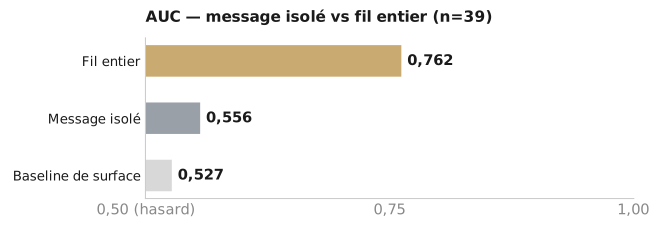
In 8 conversations out of 10, the victim was totally absent — completely silent — during 46 to 61% of offensive messages. The group continued talking about her while she was no longer there to respond. This is not a decline. It is a rupture.

Message thread — disappearance

A real conversation thread. The victim's presence (green) drops suddenly while offensive messages continue.

The Whisper is not someone complaining less and less loudly. It is someone who has ceased to exist in the conversation — while others continue talking about them.

This distinction changes everything about detection. And it is, to our knowledge, the first time it has been documented in this way.

06 — Where we stand · June 2026

The ceiling is not in the algorithm. It's in the data.

62% of bullying situations detected
Run 6 · current champion
2%* false alarm rate (balanced set)
* update 17/06: on real everyday French we measured ~34%, brought down to ~10% after a fix — not yet under control. Details: dossier.
74% of direct harassment detected
Run 6
26 researchers contacted
across 6 countries

To go further, we need more real adolescent conversations. Here is where things stand:

DatasetCountryNUse for ShieldyStatus
CyberAgressionAdo-Large🇫🇷5,608 msgsReal French teen conversations — current engineIn production
ECLS-K🇺🇸4,054 children26% on chronic trajectory — calibrationExploited
TRAILS🇳🇱2,230 adolescentsTemperament at 11 → trajectory at 13Request submitted
ALSPAC🇬🇧14,541Attachment + longitudinal bullyingIn preparation
krisenchat / SNARE🇩🇪 🇳🇱10,000+Real teen crisis conversationsContact ongoing
07 — The next question

Can we see at age 11 which child will become a chronic victim at 13?

We know how to detect a whisper in a conversation. But can we see, as early as age 11, which child is at risk of becoming a chronic victim at 13 — before bullying has even begun?

Dutch researchers followed 2,230 adolescents for 24 years. They measured, among other things, each child's capacity to understand what others feel. Our hypothesis: children with low mentalisation capacity at age 11 are disproportionately represented among chronic victimisation trajectories at age 13.

Hypothesis H2 · TRAILS application submitted June 13, 2026 · Reference: Fonagy & Luyten (2009)

If this holds, it changes the logic of prevention entirely. Not after the crisis — before. Not targeting the victim — targeting the whole class, by strengthening mentalisation from age 10–11.

We are waiting for the data. It is the kind of wait that is worth something.

Next update
  • Replies from the 26 researchers contacted worldwide
  • TRAILS cohort data access decision (N=2,230, Netherlands)
  • Run 12+ if new real data arrives
  • First test on real group conversations (SNARE / krisenchat)